Showing posts with label Kaiser. Show all posts

Friday, March 16, 2012

1955 Kaiser Full-Sizes

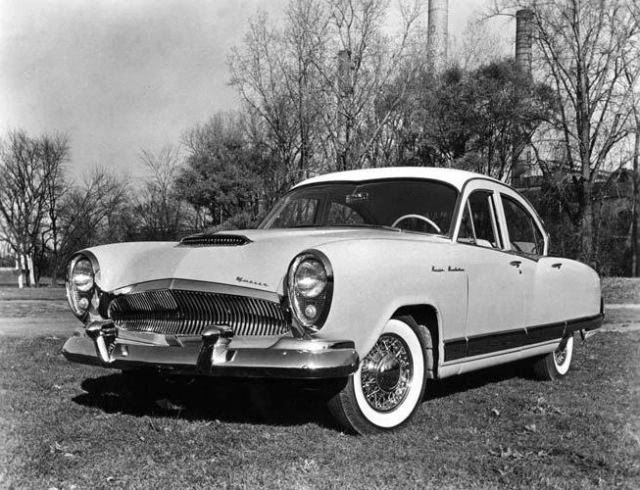
Though the production of the Kaiser passenger car seemed not to be restarted after the 1954 model year, this fine automobile makes a short comeback in January 1955. Three months before, Henry J. Kaiser has signed an agreement planning the continuation of the car’s construction in Argentina and, before a plant could be readied in the country, production starts again in America. All cars produced are supercharged Manhattan, almost identical to the models seen last year, and most of them are exported to South America. Nevertheless, a few cars - slightly more than two hundreds - are sold in the United States, along with some unsold 1954 cars fitted with new serial numbers. The last Manhattans are shipped to Buenos Aires in June 1955, and none will be built in the U.S. in the future - the decision is final this time, as all production machinery is soon dismantled and also sent to Argentina.

The firm had chosen the buffalo as its emblem to symbolize its willingness to produce a front-wheel-drive automobile - ironically, it never did, apart from a few prototypes.


Kaiser Manhattan
Photobucket
● Introduction: February 1950 for this generation of Kaiser models, March 1952 for the Manhattan. Construction: body on separate chassis. Engine: water-cooled supercharged inline six, 3.7-litre, 140 hp, mounted at the front. Transmission: to the rear wheels through a three-speed manual gearbox. Three-speed automatic gearbox optional. Suspension: independent at the front, rigid axle at the rear. Brakes: hydraulic, to drums on all four wheels. Servo optional. Length: 536 cm. Top speed: 145 kph. Range: two-door club sedan, four-door sedan.


Any mistake you’ve just spotted? A detail to add? A suggestion? Don’t hesitate to leave a comment!

Click to learn more about the Kaiser's heir, the Argentinean-built IKA Carabela.
Click to jump to another model year of the same car: 195019511952195319541955
Click here to return to a list of all Kaiser vehicles presented on this blog.
Click here to return to this blog’s initial post, featuring a list of all vehicles already presented.


1954 Kaiser Full-Sizes

Kaiser continues to sell its 1953 range until February 1954, when a simplified line-up is introduced as the company’s 1954 range.


Kaiser Carolina
A strip-down version of the Deluxe, this cheap but plain Carolina struggles to find its place on the market.
Photobucket
● Introduction: February 1950 for this generation of Kaiser models, March 1953 for the Carolina. Construction: body on separate chassis. Engine: water-cooled inline six, 3.7-litre, 118 hp, mounted at the front. Transmission: to the rear wheels through a three-speed manual gearbox. Three-speed automatic gearbox optional. Suspension: independent at the front, rigid axle at the rear. Brakes: hydraulic, to drums on all four wheels. Length: 536 cm. Top speed: 135 kph. Range: two-door club sedan, four-door sedan.


Kaiser Deluxe
Photobucket
● Introduction: February 1950 for this generation of Kaiser models, March 1952 for the updated Deluxe. Construction: body on separate chassis. Engine: water-cooled inline six, 3.7-litre, 118 hp, mounted at the front. Transmission: to the rear wheels through a three-speed manual gearbox. Three-speed automatic gearbox optional. Suspension: independent at the front, rigid axle at the rear. Brakes: hydraulic, to drums on all four wheels. Length: 536 cm. Top speed: 135 kph. Range: two-door club sedan, four-door sedan, four-door “Traveler” utility sedan.


Kaiser Manhattan
Photobucket
● Introduction: February 1950 for this generation of Kaiser models, March 1952 for the Manhattan. Construction: body on separate chassis. Engine: water-cooled inline six, 3.7-litre, 118 hp, mounted at the front. Transmission: to the rear wheels through a three-speed manual gearbox. Three-speed automatic gearbox optional. Suspension: independent at the front, rigid axle at the rear. Brakes: hydraulic, to drums on all four wheels. Length: 536 cm. Top speed: 135 kph. Range: two-door club sedan, four-door sedan, four-door “Traveler” utility sedan.


Kaiser Dragon
The extravagant Dragon virtually includes as standard equipment all possible options, among them a Hydra-Matic automatic transmission, air conditioning, radio, tinted glass and vinyl-covered roof.
Photobucket
● Introduction: February 1950 for this generation of Kaiser models, October 1952 for the Dragon. Construction: body on separate chassis. Engine: water-cooled inline six, 3.7-litre, 118 hp, mounted at the front. Transmission: to the rear wheels through a three-speed automatic gearbox. Suspension: independent at the front, rigid axle at the rear. Brakes: hydraulic, to drums on all four wheels. Length: 536 cm. Top speed: 135 kph. Range: four-door sedan.


1954 models, replacing the extended 1953 range:

It is not before February 1954 that Kaiser unveils its models for the year. They feature a rather simple but extremely elegant front end, with a wide concave grille flanked by headlights already seen elsewhere - Kaiser’s designers apparently got their inspiration from the Buick XP-300’s headlights’ bezels, which they were fond of. A new wraparound backlight is fitted at the rear - confusingly, a few thousands of unsold 1953 cars are re-equipped with the new grille, headlights and rear lights, but retain their old type rear window… Under this new guise, the Kaiser is more elegant than ever. Alas, production lasts only until June 1954, after which the plant is converted for the production of Willys vehicles.


Kaiser Special
Photobucket
● Introduction: February 1950 for this generation of Kaiser models, February 1954 for the Special. Construction: body on separate chassis. Engine: water-cooled inline six, 3.7-litre, 118 hp, mounted at the front. Transmission: to the rear wheels through a three-speed manual gearbox. Three-speed automatic gearbox optional. Suspension: independent at the front, rigid axle at the rear. Brakes: hydraulic, to drums on all four wheels. Servo optional. Length: 536 cm. Top speed: 135 kph. Range: two-door club sedan, four-door sedan.


Kaiser Manhattan
Henry J. Kaiser having opted to spend its limited budget in cosmetic improvements rather than invest it in the construction of a V-8 engine, though such a block has been designed by his engineers, his cars seriously lack power as a race is on for ever higher outputs. A stopgap solution, a compressor is now fitted to the old Continental six powering the Manhattan, boosting it to a slightly more acceptable figure and allowing it to offer “power on demand”, as Kaiser’s advertisement people put it.
Photobucket
● Introduction: February 1950 for this generation of Kaiser models, March 1952 for the Manhattan. Construction: body on separate chassis. Engine: water-cooled supercharged inline six, 3.7-litre, 140 hp, mounted at the front. Transmission: to the rear wheels through a three-speed manual gearbox. Three-speed automatic gearbox optional. Suspension: independent at the front, rigid axle at the rear. Brakes: hydraulic, to drums on all four wheels. Servo optional. Length: 536 cm. Top speed: 145 kph. Range: two-door club sedan, four-door sedan.


Any mistake you’ve just spotted? A detail to add? A suggestion? Don’t hesitate to leave a comment!

Click to jump to another model year of the same car: 195019511952195319541955
Click here to return to a list of all Kaiser vehicles presented on this blog.
Click here to return to this blog’s initial post, featuring a list of all vehicles already presented.


1953 Kaiser Full-Sizes

Introduced during the 1952 model year, the Deluxe and Manhattan models are carried over, but soon joined by a luxurious Dragon, then a much cheaper Carolina. In April 1953, and despite financial losses, Kaiser purchases Willys-Overland to form Kaiser-Willys.


Kaiser Deluxe
Photobucket
● Introduction: February 1950 for this generation of Kaiser models, March 1952 for the updated Deluxe. Construction: body on separate chassis. Engine: water-cooled inline six, 3.7-litre, 118 hp, mounted at the front. Transmission: to the rear wheels through a three-speed manual gearbox. Three-speed automatic gearbox optional. Suspension: independent at the front, rigid axle at the rear. Brakes: hydraulic, to drums on all four wheels. Length: 536 cm. Top speed: 135 kph. Range: two-door club sedan, four-door sedan, four-door “Traveler” utility sedan.


Kaiser Manhattan
Photobucket
● Introduction: February 1950 for this generation of Kaiser models, March 1952 for the Manhattan. Construction: body on separate chassis. Engine: water-cooled inline six, 3.7-litre, 118 hp, mounted at the front. Transmission: to the rear wheels through a three-speed manual gearbox. Three-speed automatic gearbox optional. Suspension: independent at the front, rigid axle at the rear. Brakes: hydraulic, to drums on all four wheels. Length: 536 cm. Top speed: 135 kph. Range: two-door club sedan, four-door sedan, four-door “Traveler” utility sedan.


Kaiser Dragon
The extravagant Dragon virtually includes as standard equipment all possible options, among them a Hydra-Matic automatic transmission, air conditioning, radio, tinted glass and vinyl-covered roof.
Photobucket
● Introduction: February 1950 for this generation of Kaiser models, October 1952 for the Dragon. Construction: body on separate chassis. Engine: water-cooled inline six, 3.7-litre, 118 hp, mounted at the front. Transmission: to the rear wheels through a three-speed automatic gearbox. Suspension: independent at the front, rigid axle at the rear. Brakes: hydraulic, to drums on all four wheels. Length: 536 cm. Top speed: 135 kph. Range: four-door sedan.


Kaiser Carolina
During the year, Kaiser adds a strip-down version of its Deluxe, but this cheap but plain Carolina struggles to find its place on the market.
Photobucket
● Introduction: February 1950 for this generation of Kaiser models, March 1953 for the Carolina. Construction: body on separate chassis. Engine: water-cooled inline six, 3.7-litre, 118 hp, mounted at the front. Transmission: to the rear wheels through a three-speed manual gearbox. Three-speed automatic gearbox optional. Suspension: independent at the front, rigid axle at the rear. Brakes: hydraulic, to drums on all four wheels. Length: 536 cm. Top speed: 135 kph. Range: two-door club sedan, four-door sedan.


Any mistake you’ve just spotted? A detail to add? A suggestion? Don’t hesitate to leave a comment!

Click to jump to another model year of the same car: 195019511952195319541955
Click here to return to a list of all Kaiser vehicles presented on this blog.
Click here to return to this blog’s initial post, featuring a list of all vehicles already presented.


1952 Kaiser Full-Sizes

Once again in 1952, Kaiser proposes only a reheated range, now dubbed “Virginian”, during the first part of the model year, before introducing a face-lifted range during Spring. Early models receive a “Virginian” scripts on the front wings to differentiate them from previous models. Kaiser announces that a Continental spare tyre kit is now added to the option list.


Kaiser Virginian Special
● Introduction: February 1950 for this generation of Kaiser models, 1951 for the Virginian. Construction: body on separate chassis. Engine: water-cooled inline six, 3.7-litre, 115 hp, mounted at the front. Transmission: to the rear wheels through a three-speed manual gearbox. Three-speed automatic gearbox optional. Suspension: independent at the front, rigid axle at the rear. Brakes: hydraulic, to drums on all four wheels. Length: 530 cm. Top speed: 135 kph. Range: two-door business coupe, two-door sedan, two-door “Traveler” utility sedan, four-door sedan, four-door “Traveler” utility sedan.


Kaiser Virginian Deluxe
Photobucket
● Introduction: February 1950 for this generation of Kaiser models, 1951 for the Virginian. Engine: water-cooled inline six, 3.7-litre, 115 hp, mounted at the front. Transmission: to the rear wheels through a three-speed manual gearbox. Three-speed automatic gearbox optional. Suspension: independent at the front, rigid axle at the rear. Brakes: hydraulic, to drums on all four wheels. Length: 534 cm. Top speed: 135 kph. Range: two-door club coupe, two-door sedan, two-door “Traveler” utility sedan, four-door sedan, four-door “Traveler” utility sedan.


Mid-1952 models:

Spring brings an updated Kaiser, with a modified front grille and a one-piece windshield. The Deluxe becomes the base model, while the Manhattan is adopted as Kaiser’s most expensive model, following the suspension of Frazer’s production.


Kaiser Deluxe
Photobucket
● Introduction: February 1950 for this generation of Kaiser models, March 1952 for the updated Deluxe. Construction: body on separate chassis. Engine: water-cooled inline six, 3.7-litre, 115 hp, mounted at the front. Transmission: to the rear wheels through a three-speed manual gearbox. Three-speed automatic gearbox optional. Suspension: independent at the front, rigid axle at the rear. Brakes: hydraulic, to drums on all four wheels. Length: 536 cm. Top speed: 135 kph. Range: two-door business coupe, two-door sedan, two-door “Traveler” utility sedan, four-door sedan, four-door “Traveler” utility sedan.


Kaiser Manhattan
Photobucket
● Introduction: February 1950 for this generation of Kaiser models, March 1952 for the Manhattan. Construction: body on separate chassis. Engine: water-cooled inline six, 3.7-litre, 115 hp, mounted at the front. Transmission: to the rear wheels through a three-speed manual gearbox. Three-speed automatic gearbox optional. Suspension: independent at the front, rigid axle at the rear. Brakes: hydraulic, to drums on all four wheels. Length: 536 cm. Top speed: 135 kph. Range: two-door club coupe, two-door sedan, two-door “Traveler” utility sedan, four-door sedan, four-door “Traveler” utility sedan.


Any mistake you’ve just spotted? A detail to add? A suggestion? Don’t hesitate to leave a comment!

Click to jump to another model year of the same car: 195019511952195319541955
Click here to return to a list of all Kaiser vehicles presented on this blog.
Click here to return to this blog’s initial post, featuring a list of all vehicles already presented.


1951 Kaiser Full-Sizes

Introduced half-way through the 1950 middle year, the Kaiser do not change much for 1951. Most obvious difference is the addition of chrome strips onto the body sides of the Special, that were all too bare up to now.


Kaiser Special
Photobucket
● Introduction: February 1950. Construction: body on separate chassis. Engine: water-cooled inline six, 3.7-litre, 115 hp, mounted at the front. Transmission: to the rear wheels through a three-speed manual gearbox. Three-speed automatic gearbox optional. Suspension: independent at the front, rigid axle at the rear. Brakes: hydraulic, to drums on all four wheels. Length: 530 cm. Top speed: 135 kph. Range: two-door business coupe, two-door club coupe, two-door sedan, two-door “Traveler” utility sedan, four-door sedan, four-door “Traveler” utility sedan.


Kaiser Deluxe
Photobucket
● Introduction: February 1950. Construction: body on separate chassis. Engine: water-cooled inline six, 3.7-litre, 115 hp, mounted at the front. Transmission: to the rear wheels through a three-speed manual gearbox. Three-speed automatic gearbox optional. Suspension: independent at the front, rigid axle at the rear. Brakes: hydraulic, to drums on all four wheels. Length: 534 cm. Top speed: 135 kph. Range: two-door club coupe, two-door sedan, two-door “Traveler” utility sedan, four-door sedan, four-door “Traveler” utility sedan.


Any mistake you’ve just spotted? A detail to add? A suggestion? Don’t hesitate to leave a comment!

Click to jump to another model year of the same car: 195019511952195319541955
Click here to return to a list of all Kaiser vehicles presented on this blog.
Click here to return to this blog’s initial post, featuring a list of all vehicles already presented.


1950 Kaiser Full-Sizes

This year’s Kaisers are totally identical to last year’s models. This allows Kaiser-Frazer to give new serial numbers to the cars that remained unsold last year - no less than 20% of its production. Kaiser’s strategy is to wait for the mid-year introduction of a brand new car, a beautiful early 1951 model again penned by Howard “Dutch” Darrin.


Kaiser Special
Photobucket
● Introduction: June 1946 for the original Frazer, August 1946 for its Kaiser counterpart. Construction: body on separate chassis. Engine: water-cooled inline six, 3.7-litre, 100 hp, mounted at the front. Transmission: to the rear wheels through a three-speed manual gearbox. Suspension: independent at the front, rigid axle at the rear. Brakes: hydraulic, to drums on all four wheels. Length: 516 cm. Top speed: 125 kph. Range: four-door sedan, four-door “Traveler” utility sedan. Note: the utility sedan is called a “four-door”, though one rear door was welded into place due to the positioning of the spare tyre behind it. Nevertheless, some of these cars are also fitted with four doors that can be truly opened.


Kaiser Deluxe
The Deluxe most notably adds to the Standard’s equipment the “dual manifold” 112 hp engine, along with wide chromed rocker panels. A particularity of the Deluxe is that it sports chromed scripts on the front wings indicating the name of the car’s paint.
Photobucket
● Introduction: June 1946 for the original Frazer, August 1946 for its Kaiser counterpart, September 1948 for the Deluxe, January 1949 for the four-door convertible. Construction: body on separate chassis. Engine: water-cooled inline six, 3.7-litre, 112 hp, mounted at the front. Transmission: to the rear wheels through a three-speed manual gearbox. Suspension: independent at the front, rigid axle at the rear. Brakes: hydraulic, to drums on all four wheels. Length: 516 cm. Top speed: 130 kph. Range: four-door sedan, four-door convertible sedan.


Kaiser Vagabond
The Vagabond combines the rich level of equipment of the Deluxe with the practicality of the utility sedan’s body.
Photobucket
● Introduction: June 1946 for the original Frazer, August 1946 for its Kaiser counterpart, September 1948 for the Vagabond. Construction: body on separate chassis. Engine: water-cooled inline six, 3.7-litre, 112 hp, mounted at the front. Transmission: to the rear wheels through a three-speed manual gearbox. Suspension: independent at the front, rigid axle at the rear. Brakes: hydraulic, to drums on all four wheels. Length: 516 cm. Top speed: 130 kph. Range: four-door utility sedan.


Kaiser Virginian
The Virginian hardtop sedan actually retains window frames similar to those found of the convertible sedan. Its roof is covered by vinyl and its interior is rather luxurious, but its price is staggering.
Photobucket
● Introduction: June 1946 for the original Frazer, August 1946 for its Kaiser counterpart, September 1948 for the Virginian. Construction: body on separate chassis. Engine: water-cooled inline six, 3.7-litre, 112 hp, mounted at the front. Transmission: to the rear wheels through a three-speed manual gearbox. Suspension: independent at the front, rigid axle at the rear. Brakes: hydraulic, to drums on all four wheels. Length: 516 cm. Top speed: 130 kph. Range: four-door “hardtop” sedan.


Kaiser Taxi
Kaiser has developed a version of the Special specially designed for taxicab operators. Suspension is reinforced and the seats are fitted with a tougher, more durable material, while the taximeter is installed in the glove box. The Kaiser taxi come standard with the dual manifold 112 hp engine.
Photobucket
● Introduction: June 1946 for the original Frazer, August 1946 for its Kaiser counterpart, September 1948 for the taxi. Construction: body on separate chassis. Engine: water-cooled inline six, 3.7-litre, 112 hp, mounted at the front. Transmission: to the rear wheels through a three-speed manual gearbox. Suspension: independent at the front, rigid axle at the rear. Brakes: hydraulic, to drums on all four wheels. Length: 516 cm. Top speed: 130 kph. Range: four-door sedan.


Mid-1950 models:

Early in 1950, Kaiser releases a new generation of cars, roughly similar to the models they replace from a mechanical point of view, but graced by a supremely elegant body. Again drawn by Howard “Dutch” Darrin, it features this designer’s characteristic side “crease” just ahead of the rear wings. Dubbed “Anatomic Design” by Kaiser’s publicists, this striking style allows the new Kaiser to pretend to the title of this year’s most beautiful American automobile. The success of the previous Traveler utility sedan justifies this original version to be renewed among Kaiser’s latest range. A Hydra-Matic automatic gearbox is now available as an option, courtesy of General Motors.


Kaiser Special
Photobucket
● Introduction: February 1950. Construction: body on separate chassis. Engine: water-cooled inline six, 3.7-litre, 115 hp, mounted at the front. Transmission: to the rear wheels through a three-speed manual gearbox. Three-speed automatic gearbox optional. Suspension: independent at the front, rigid axle at the rear. Brakes: hydraulic, to drums on all four wheels. Length: 530 cm. Top speed: 135 kph. Range: two-door business coupe, two-door club coupe, two-door sedan, two-door “Traveler” utility sedan, four-door sedan, four-door “Traveler” utility sedan.


Kaiser Deluxe
Photobucket
● Introduction: February 1950. Construction: body on separate chassis. Engine: water-cooled inline six, 3.7-litre, 115 hp, mounted at the front. Transmission: to the rear wheels through a three-speed manual gearbox. Three-speed automatic gearbox optional. Suspension: independent at the front, rigid axle at the rear. Brakes: hydraulic, to drums on all four wheels. Length: 534 cm. Top speed: 135 kph. Range: two-door club coupe, two-door sedan, two-door “Traveler” utility sedan, four-door sedan, four-door “Traveler” utility sedan.


Any mistake you’ve just spotted? A detail to add? A suggestion? Don’t hesitate to leave a comment!

Click to jump to another model year of the same car: 1947194819491950
Or click here for the new generation of Kaiser: 195019511952195319541955
Click here to return to a list of all Kaiser vehicles presented on this blog.
Click here to return to this blog’s initial post, featuring a list of all vehicles already presented.


1949 Kaiser Full-Sizes

In expectation for the first post-war cars by the Big Three, nineteen forty-nine brings news at Kaiser in the form of a wide horizontal grille of simpler and more elegant design than its predecessor, enlarged taillights and a revised line-up. It includes a peculiar utility car, with a silhouette similar to the sedan’s, but fitted with a rear hatch in two parts, folding rear seats and a fixed rear left door due to the repositioning of the spare tyre. Half-station wagon, half-sedan, the car sells well honourably to a very reasonable price. Other new models for the year are the convertible sedan - a rare body type nowadays - which keeps its window frames intact in order for the chassis to retain its rigidity without any costly reinforcement; and a hardtop sedan, in which thick pillars do not totally disappear, but are rather replaced by thin frames. Despite all of these efforts, sales plummet this year.


Kaiser Special
Photobucket
● Introduction: June 1946 for the original Frazer, August 1946 for its Kaiser counterpart. Construction: body on separate chassis. Engine: water-cooled inline six, 3.7-litre, 100 hp, mounted at the front. Transmission: to the rear wheels through a three-speed manual gearbox. Suspension: independent at the front, rigid axle at the rear. Brakes: hydraulic, to drums on all four wheels. Length: 516 cm. Top speed: 125 kph. Range: four-door sedan, four-door “Traveler” utility sedan. Note: the utility sedan is called a “four-door”, though one rear door was welded into place due to the positioning of the spare tyre behind it. Nevertheless, some of these cars are also fitted with four doors that can be truly opened.


Kaiser Deluxe
The Custom, which had too limited an appeal, is replaced by a richly appointed Deluxe this year. The “dual manifold” 112 hp engine is now standard on this version, along with wide chromed rocker panels. A particularity of the Deluxe is that it sports chromed scripts on the front wings indicating the name of the car’s paint.
Photobucket
● Introduction: June 1946 for the original Frazer, August 1946 for its Kaiser counterpart, September 1948 for the Deluxe, January 1949 for the four-door convertible. Construction: body on separate chassis. Engine: water-cooled inline six, 3.7-litre, 112 hp, mounted at the front. Transmission: to the rear wheels through a three-speed manual gearbox. Suspension: independent at the front, rigid axle at the rear. Brakes: hydraulic, to drums on all four wheels. Length: 516 cm. Top speed: 130 kph. Range: four-door sedan, four-door convertible sedan.


Kaiser Vagabond
The new Vagabond combines the rich level of equipment of the Deluxe with the practicality of the utility sedan’s body.
Photobucket
● Introduction: June 1946 for the original Frazer, August 1946 for its Kaiser counterpart, September 1948 for the Vagabond. Construction: body on separate chassis. Engine: water-cooled inline six, 3.7-litre, 112 hp, mounted at the front. Transmission: to the rear wheels through a three-speed manual gearbox. Suspension: independent at the front, rigid axle at the rear. Brakes: hydraulic, to drums on all four wheels. Length: 516 cm. Top speed: 130 kph. Range: four-door utility sedan.


Kaiser Virginian
The Virginian hardtop sedan actually retains window frames similar to those found of the convertible sedan. Its roof is covered by vinyl and its interior is rather luxurious, but its price is staggering.
Photobucket
● Introduction: June 1946 for the original Frazer, August 1946 for its Kaiser counterpart, September 1948 for the Virginian. Construction: body on separate chassis. Engine: water-cooled inline six, 3.7-litre, 112 hp, mounted at the front. Transmission: to the rear wheels through a three-speed manual gearbox. Suspension: independent at the front, rigid axle at the rear. Brakes: hydraulic, to drums on all four wheels. Length: 516 cm. Top speed: 130 kph. Range: four-door “hardtop” sedan.


Kaiser Taxi
For 1949, Kaiser has developed a version of the Special specially designed for taxicab operators. Suspension is reinforced and the seats are fitted with a tougher, more durable material, while the taximeter is installed in the glove box. The Kaiser taxi come standard with the dual manifold 112 hp engine.
Photobucket
● Introduction: June 1946 for the original Frazer, August 1946 for its Kaiser counterpart, September 1948 for the taxi. Construction: body on separate chassis. Engine: water-cooled inline six, 3.7-litre, 112 hp, mounted at the front. Transmission: to the rear wheels through a three-speed manual gearbox. Suspension: independent at the front, rigid axle at the rear. Brakes: hydraulic, to drums on all four wheels. Length: 516 cm. Top speed: 130 kph. Range: four-door sedan.


Any mistake you’ve just spotted? A detail to add? A suggestion? Don’t hesitate to leave a comment!

Click to jump to another model year of the same car: 1947194819491950
Click here to return to a list of all Kaiser vehicles presented on this blog.
Click here to return to this blog’s initial post, featuring a list of all vehicles already presented.


1954 Kaiser Darrin

The final production model of the Kaiser Darrin fibreglass sports car is at last released in November 1953, though sales do not start before the following January. An obvious departure from the prototype is the adoption of a split windshield. Under the bonnet, the Darrin finally has to settle for a conventional Willys F-head six, with a single carburettor.


Kaiser Darrin
Photobucket
● Introduction: November 1953. Construction: fibreglass body on separate chassis. Engine: water-cooled inline six, 2.6-litre, 90 hp, mounted at the front. Transmission: to the rear wheels through a four-speed manual gearbox. Suspension: independent at the front, rigid axle at the rear. Brakes: hydraulic, to drums on all four wheels. Length: 465 cm. Top speed: 150 kph. Range: two-door sports convertible.


Any mistake you’ve just spotted? A detail to add? A suggestion? Don’t hesitate to leave a comment!

Click to jump to another model year of the same car: 195319541955
Click here to return to a list of all Kaiser vehicles presented on this blog.
Click here to return to this blog’s initial post, featuring a list of all vehicles already presented.


1953 Kaiser Darrin

During September 1952, Kaiser announces the project of a light two-seater sports car fitted with a fibreglass body. First prototypes are exhibited from February 1953, but no production starts during this model year. Easily recognizable as another brainchild of designer Howard “Dutch” Darrin, the KF-161 prototype features radical ideas, such as doors that slide forward into the long front wings. Provided by Willys, its engine is a specially modified L-head six fed by three carburettors.


Kaiser KF-161 Darrin
Photobucket
● Introduction: February 1953 as a prototype. Construction: fibreglass body on separate chassis. Engine: water-cooled inline six, 2.6-litre, 100 hp, mounted at the front. Transmission: to the rear wheels through a four-speed manual gearbox. Suspension: independent at the front, rigid axle at the rear. Brakes: hydraulic, to drums on all four wheels. Length: 465 cm. Top speed: n/a. Range: two-door sports convertible.


Any mistake you’ve just spotted? A detail to add? A suggestion? Don’t hesitate to leave a comment!

Click to jump to another model year of the same car: 195319541955
Click here to return to a list of all Kaiser vehicles presented on this blog.
Click here to return to this blog’s initial post, featuring a list of all vehicles already presented.


1955 Kaiser Darrin

Unfortunately, Kaiser stops the production of its Kaiser Darrin convertible after all of its operations are concentrated in Willys’ Toledo factory. Still, some leftover cars are sold during the 1955 model year, while remaining leftover bodies and parts are purchased by the car’s designer Howard “Dutch” Darrin, who has decided to continue to sell the car in limited numbers.


Kaiser Darrin
Photobucket
● Introduction: November 1953. Construction: fibreglass body on separate chassis. Engine: water-cooled inline six, 2.6-litre, 90 hp, mounted at the front. Transmission: to the rear wheels through a four-speed manual gearbox. Suspension: independent at the front, rigid axle at the rear. Brakes: hydraulic, to drums on all four wheels. Length: 465 cm. Top speed: 150 kph. Range: two-door sports convertible.


Any mistake you’ve just spotted? A detail to add? A suggestion? Don’t hesitate to leave a comment!

Click to jump to another model year of the same car: 195319541955
Click here to return to a list of all Kaiser vehicles presented on this blog.
Click here to return to this blog’s initial post, featuring a list of all vehicles already presented.


Sunday, March 11, 2012

1948 Kaiser Full-Sizes

America’s newest automobile has met with instant success! Despite the limited power provided by its Continental “Red Seal” engine, its first customers enjoy its superior ride, excellent handling - courtesy of a low centre of gravity - and roomy passenger compartment.


Kaiser Special
Though some have been ironical about the “bathtub” style penned by designer Howard “Dutch” Darrin, the Kaiser nonetheless enjoys one of the freshest look in the automobile scene. This has guaranteed a remarkable share of the market to its manufacturer in its first year of activity, in the face of competitors proposing mostly reheated pre-war designs.
Photobucket
● Introduction: June 1946 for the original Frazer, August 1946 for its Kaiser counterpart. Construction: body on separate chassis. Engine: water-cooled inline six, 3.7-litre, 100 hp, mounted at the front. Optional engine: inline six, 3.7-litre, 112 hp. Transmission: to the rear wheels through a three-speed manual gearbox. Suspension: independent at the front, rigid axle at the rear. Brakes: hydraulic, to drums on all four wheels. Length: 516 cm. Top speed: 125 kph. Range: four-door sedan.


Kaiser Custom
Introduced late during last year, the plusher Custom still struggles to attract customers, due to its high price that places it in the same category as a Buick.
Photobucket
● Introduction: June 1946 for the original Frazer, August 1946 for its Kaiser counterpart, September 1947 for the Custom. Construction: body on separate chassis. Engine: water-cooled inline six, 3.7-litre, 100 hp, mounted at the front. Optional engine: inline six, 3.7-litre, 112 hp. Transmission: to the rear wheels through a three-speed manual gearbox. Suspension: independent at the front, rigid axle at the rear. Brakes: hydraulic, to drums on all four wheels. Length: 516 cm. Top speed: 125 kph. Range: four-door sedan.


Any mistake you’ve just spotted? A detail to add? A suggestion? Don’t hesitate to leave a comment!

Click to jump to another model year of the same car: 1947194819491950
Click here to return to a list of all Kaiser vehicles presented on this blog.
Click here to return to this blog’s initial post, featuring a list of all vehicles already presented.


1947 Kaiser Full-Sizes

Here comes the biggest news in the American, post-war automotive scene: the Kaiser, built by shipbuilding magnate Henry J. Kaiser, who has made himself famous during the conflict with his ability of mass-producing cargo ships to support the war effort. Despite its very modern “pontoon” design, the Kaiser is somewhat disappointing, its manufacturer having, along the years, promised a revolutionary popular car, then a front-wheel drive, unitized construction sedan. All of these projects have given way to a much more conventional automobile, which is nothing more than a lower-priced Frazer. Nevertheless, Henry J. Kaiser and his partner Joseph W. Frazer have great ambitions for their cars, having secured the Willow Run plant - the largest factory in the world - for their production.


Kaiser Special
With a pleasing new body penned by designer Howard “Dutch” Darrin hiding a rather conventional mechanical arrangement, the Kaiser is introduced in August 1946, though production starts as early as June. Power is provided by a Continental six, while the gearbox is a Borg-Warner. Being the only brand new car in America, apart from the Studebaker, it immediately records a sizeable success.
Photobucket
● Introduction: June 1946 for the original Frazer, August 1946 for its Kaiser counterpart. Construction: body on separate chassis. Engine: water-cooled inline six, 3.7-litre, 100 hp, mounted at the front. Optional engine: inline six, 3.7-litre, 112 hp. Transmission: to the rear wheels through a three-speed manual gearbox. Suspension: independent at the front, rigid axle at the rear. Brakes: hydraulic, to drums on all four wheels. Length: 516 cm. Top speed: 125 kph. Range: four-door sedan.


Kaiser Custom
Near the end of the model year, Kaiser introduces a more refined Custom variant of its car. It is priced between the two models proposed by Frazer, which does not help providing a particular identity to the two new brands.
● Introduction: June 1946 for the original Frazer, August 1946 for its Kaiser counterpart, September 1947 for the Custom. Construction: body on separate chassis. Engine: water-cooled inline six, 3.7-litre, 100 hp, mounted at the front. Optional engine: inline six, 3.7-litre, 112 hp. Transmission: to the rear wheels through a three-speed manual gearbox. Suspension: independent at the front, rigid axle at the rear. Brakes: hydraulic, to drums on all four wheels. Length: 516 cm. Top speed: 125 kph. Range: four-door sedan.


Any mistake you’ve just spotted? A detail to add? A suggestion? Don’t hesitate to leave a comment!

Click to jump to another model year of the same car: 1947194819491950
Click here to return to a list of all Kaiser vehicles presented on this blog.
Click here to return to this blog’s initial post, featuring a list of all vehicles already presented.


Kaiser (United States, 1947-1955)

Ambitious but short-lived American company, first built alongside the sister car Frazer, then alone. Kaiser purchased Willys-Overland, then gave up its huge Willow Run factory to move to Willys' more reasonnable Toledo plant, and concentrate on the production of Jeeps instead of passenger cars. Production still continued for a while in Argentina, where the dies had been shipped.


1947 Kaiser Special and Custom

1948 Kaiser Special and Custom

1949 Kaiser Special, Deluxe, Vagabond and Virginian

1950 Kaiser Special, Deluxe, Vagabond and Virginian (1st series cars)
1950 Kaiser Special and Deluxe (2nd series cars)

1951 Kaiser Special and Deluxe

1952 Kaiser Virginian (1st series cars)
1952 Deluxe and Manhattan (2nd series cars)

1953 Kaiser Carolina, Deluxe, Manhattan and Dragon
1953 Kaiser Darrin

1954 Kaiser Carolina, Deluxe, Manhattan and Dragon (1st series cars)
1954 Kaiser Special and Manhattan (2nd series cars)
1954 Kaiser Darrin

1955 Kaiser Manhattan
1955 Kaiser Darrin


Also see Industrias Kaiser Argentina (IKA).

Click here to return to this blog’s initial post, featuring a list of all brands already presented.